Google Earth AI
Built on years of modeling the world and Gemini’s advanced reasoning, Earth AI is helping enterprises, nonprofits, and cities with everything from environmental monitoring to real-time disaster response.

Built on years of modeling the world and Gemini’s advanced reasoning, Earth AI is helping enterprises, nonprofits, and cities with everything from environmental monitoring to real-time disaster response.
Feature blogs



Featured publications
Earth AI: Unlocking Geospatial Insights with Foundation Models and Cross-Modal Reasoning
Aaron Bell
Aviad Barzilai
Roy Lee
Gia Jung
Charles Elliott
Adam Boulanger
Amr Helmy
Jacob Bien
Ruth Alcantara
Nadav Sherman
Hassler Thurston
Yotam Gigi
Bolous Jaber
Vered Silverman
Luke Barrington
Tim Thelin
Elad Aharoni
Kartik Hegde
Yuval Carny
Shravya Shetty
Yehonathan Refael
Stone Jiang
David Schottlander
Juliet Rothenberg
Luc Houriez
Yochai Blau
Joydeep Paul
Yang Chen
Yael Maguire
Aviv Slobodkin
Shlomi Pasternak
Alex Ottenwess
Jamie McPike
Per Bjornsson
Natalie Williams
Reuven Sayag
Thomas Turnbull
Ali Ahmadalipour
David Andre
Amit Aides
Ean Phing VanLee
Niv Efron
Monica Bharel
arXiv (preprint 2025), arXiv, arXiv:2510.18318
https://doi.org/10.48550/arXiv.2510.18318
(2025)
Preview abstract
Geospatial data offers immense potential for understanding our planet. However, the sheer volume and diversity of this data along with its varied resolutions, timescales, and sparsity pose significant challenges for thorough analysis and interpretation. The emergence of Foundation Models (FMs) and Large Language Models (LLMs) offers an unprecedented opportunity to tackle some of this complexity, unlocking novel and profound insights into our planet.
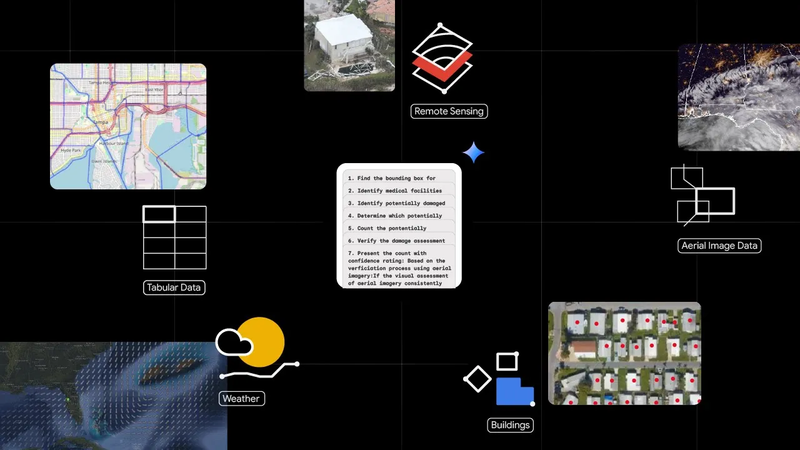
This paper introduces a comprehensive approach to developing Earth AI solutions, built upon foundation models across three key domains—Planet-scale Imagery, Population, and Environment—and an intelligent Gemini-powered reasoning engine. We present rigorous benchmarks showcasing the power and novel capabilities of our foundation models and validate that they provide complementary value to improve geospatial inference. We show that the synergy between these models unlocks superior predictive capabilities. To handle complex, multi-step queries, we developed a Gemini-powered agent that jointly reasons over our multiple foundation models along with large geospatial data sources and tools to unlock novel geospatial insights. On a new benchmark of real-world crisis scenarios, our agent demonstrates the ability to deliver critical and timely insights, effectively bridging the gap between raw geospatial data and actionable understanding.
View details
General Geospatial Inference with a Population Dynamics Foundation Model
Chaitanya Kamath
Prithul Sarker
Joydeep Paul
Yael Mayer
Sheila de Guia
Jamie McPike
Adam Boulanger
David Schottlander
Yao Xiao
Manjit Chakravarthy Manukonda
Sami Abu-El-Haija
Monica Bharel
Von Nguyen
Luke Barrington
Niv Efron
Krish Eswaran
Shravya Shetty
arXiv (2024)
Preview abstract
Supporting the health and well-being of dynamic populations around the world requires governmental agencies, organizations, and researchers to understand and reason over complex relationships between human behavior and local contexts. This support includes identifying populations at elevated risk and gauging where to target limited aid resources. Traditional approaches to these classes of problems often entail developing manually curated, task-specific features and models to represent human behavior and the natural and built environment, which can be challenging to adapt to new, or even related tasks. To address this, we introduce the Population Dynamics Foundation Model (PDFM), which aims to capture the relationships between diverse data modalities and is applicable to a broad range of geospatial tasks. We first construct a geo-indexed dataset for postal codes and counties across the United States, capturing rich aggregated information on human behavior from maps, busyness, and aggregated search trends, and environmental factors such as weather and air quality. We then model this data and the complex relationships between locations using a graph neural network, producing embeddings that can be adapted to a wide range of downstream tasks using relatively simple models. We evaluate the effectiveness of our approach by benchmarking it on 27 downstream tasks spanning three distinct domains: health indicators, socioeconomic factors, and environmental measurements. The approach achieves state-of-the-art performance on geospatial interpolation across all tasks, surpassing existing satellite and geotagged image based location encoders. In addition, it achieves state-of-the-art performance in extrapolation and super-resolution for 25 of the 27 tasks. We also show that the PDFM can be combined with a state-of-the-art forecasting foundation model, TimesFM, to predict unemployment and poverty, achieving performance that surpasses fully supervised forecasting. The full set of embeddings and sample code are publicly available for researchers. In conclusion, we have demonstrated a general purpose approach to geospatial modeling tasks critical to understanding population dynamics by leveraging a rich set of complementary globally available datasets that can be readily adapted to previously unseen machine learning tasks.
View details
Continental-scale building detection from high resolution satellite imagery
Wojciech Sirko
Yasser Salah Eddine Bouchareb
Daniel Keysers
Maxim Neumann
Moustapha Cisse
John Quinn
arXiv (2021)
Preview abstract
Identifying the locations and footprints of buildings is vital for many practical and scientific purposes, and such information can be particularly useful in developing regions where alternative data sources may be scarce. In this work, we describe a model training pipeline for detecting buildings across the entire continent of Africa, given 50cm satellite imagery. Starting with the U-Net model, widely used in satellite image analysis, we study variations in architecture, loss functions, regularization, pre-training, self-training and post-processing that increase instance segmentation performance. Experiments were carried out using a dataset of 100k satellite images across Africa containing 1.75M manually labelled building instances, and further datasets for pre-training and self-training. We report novel methods for improving performance of building detection with this type of model, including the use of mixup (mAP +0.12) and self-training with soft KL loss (mAP +0.06). The resulting pipeline obtains good results even on a wide variety of challenging rural and urban contexts, and was used to create the Open Buildings dataset of approximately 600M Africa-wide building footprints.
View details